- Visitors
- Researchers
- Students
- Community
- Information for the tourist
- Hours and fees
- How to get?
- Visitor Regulations
- Virtual tours
- Classic route
- Mystical route
- Specialized route
- Site museum
- Know the town
- Cultural Spaces
- Cao Museum
- Huaca Cao Viejo
- Huaca Prieta
- Huaca Cortada
- Ceremonial Well
- Walls
- Play at home
- Puzzle
- Trivia
- Memorize
- Crosswords
- Alphabet soup
- Crafts
- Pac-Man Moche
- Workshops and Inventory
- Micro-workshops
- Collections inventory
- News
- Researchers
- 3D Documentation of Cultural Heritage at the El Brujo Archaeological Complex: Building Digital Heritage in Peru
News
CategoriesSelect the category you want to see:
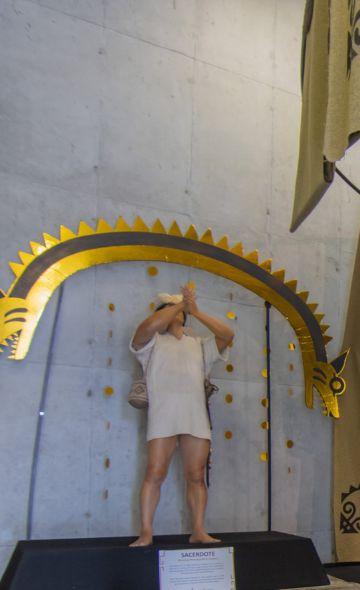
Elite Moche Burial at Huaca Cao Viejo: The Principal Priest ...
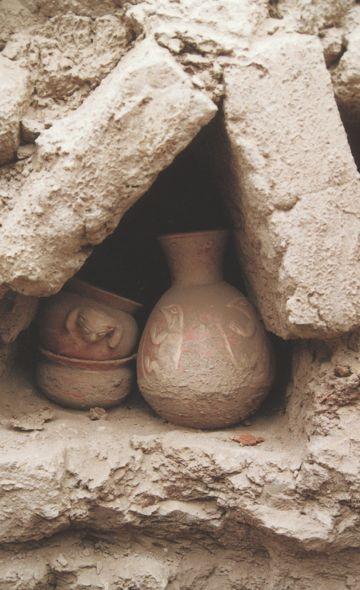
Tumbas de élite mochica en Huaca Cao Viejo: la cámara decorada Moche Elite Tombs at Huaca Cao Viejo: The Decorated Chamb ...
To receive new news.

By: Luigui Giancarlos Oliva Mera
What Is 3D Documentation of Cultural Heritage?
Visual documentation of museum collections has its origins in drawing and later photography—tools that became fundamental to museum and archaeological practice. Today, these methods have been enhanced by three-dimensional documentation, which involves creating 3D models that allow cultural assets to be recorded, analyzed, and preserved in great detail.
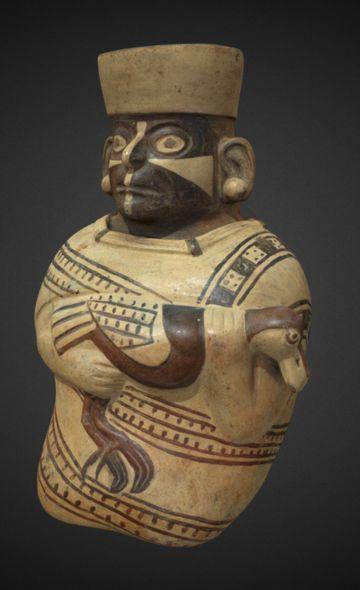
This methodology expands possibilities for research, conservation, and dissemination, while also facilitating public engagement through interactive educational strategies and innovative museum approaches such as 3D printing and augmented reality. However, the creation of digital heritage also presents challenges, including the need for high-fidelity content, optimization of complex models, reliable repositories for storage and access, and ongoing debates around the use and scope of generative artificial intelligence (Figure 1).
In this context, Fundación Wiese, in collaboration with the Swiss Federal Office of Culture, carried out the Comprehensive Cataloging Project of objects from the El Brujo Archaeological Complex, recovered over 35 years of research. Although 3D modeling was not among the main objectives, favorable logistical conditions and the work of archaeologists specialized in digital heritage documentation made it possible to develop a small 3D catalog.
This catalog consists of a selection of 11 archaeological objects digitally recorded with high fidelity, all originating from properly documented archaeological contexts obtained through controlled excavations and published research.
These efforts are based on the guidelines proposed by the UNESCO Chair on Digital Cultural Heritage at the Cyprus University of Technology, which promotes the concept of Memory Twins—an evolution of the digital twin that integrates both the tangible and intangible dimensions of cultural heritage. Proper standardization of 3D documentation enables information to be organized through metadata and the technical process to be made transparent through paradata.
Within this framework, standardization goes beyond creating high-quality digital models. It also involves structuring and clarifying information associated with each object through two key components:
- Metadata: Structured information describing the cultural asset—its origin, archaeological context, chronology, manufacturing techniques, state of conservation, and institutional record. Metadata ensures that each 3D model remains linked to scientific research and its real historical context.
- Paradata: Information explaining how the 3D model was created. This includes equipment used, technical parameters, methodological decisions, optimization processes, and software employed. Paradata ensures transparency and technical rigor.
The integration of data, metadata, and paradata transforms 3D models into tools for research and digital memory, beyond their visual value.
How Is High-Quality 3D Content Created from Archaeological Heritage?
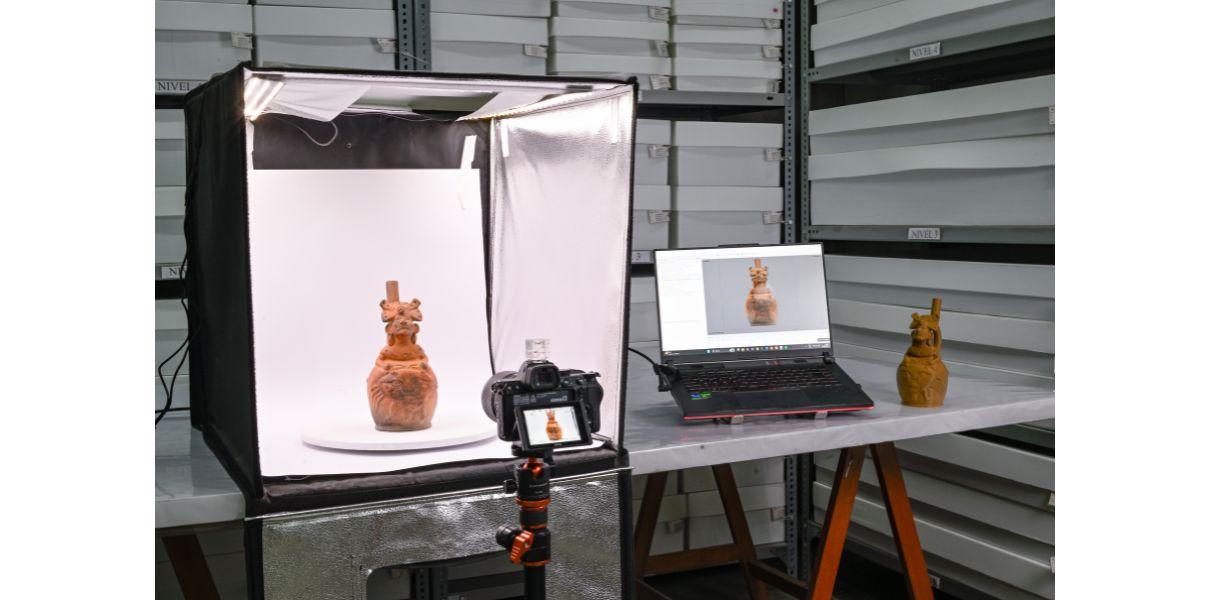
To ensure proper 3D documentation, high-precision technological tools were used, enabling not only the creation of 3D models but also the capture of highly detailed records. Equipment included a Nikon Z6 mirrorless camera, an AF Concept tripod, mirrorless lenses, a lightbox, and a gaming laptop for data processing.
After the initial data capture phase—consisting of systematic photographic recording from multiple angles—the workflow continued with image development, processing, and scaling of photogrammetric models using specialized 3D software.
Why Is 3D Model Optimization Important in Archaeology?
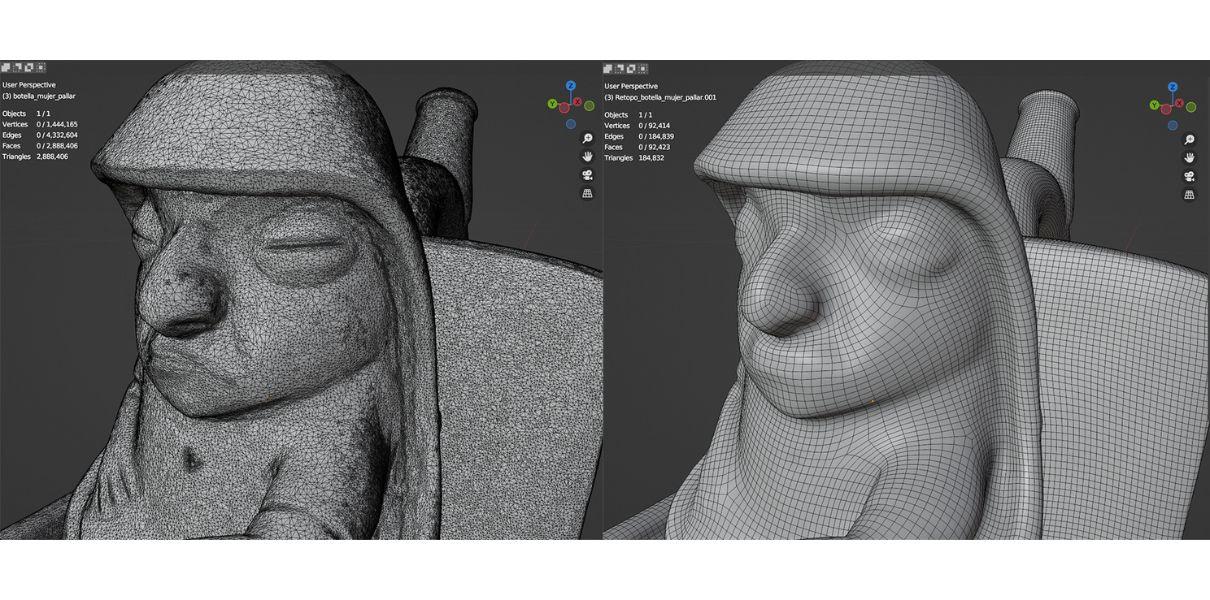
After initial processing, optimizing the 3D model becomes a crucial step. Photogrammetry software often produces models with very high polygon counts, resulting in heavy and difficult-to-manage files.
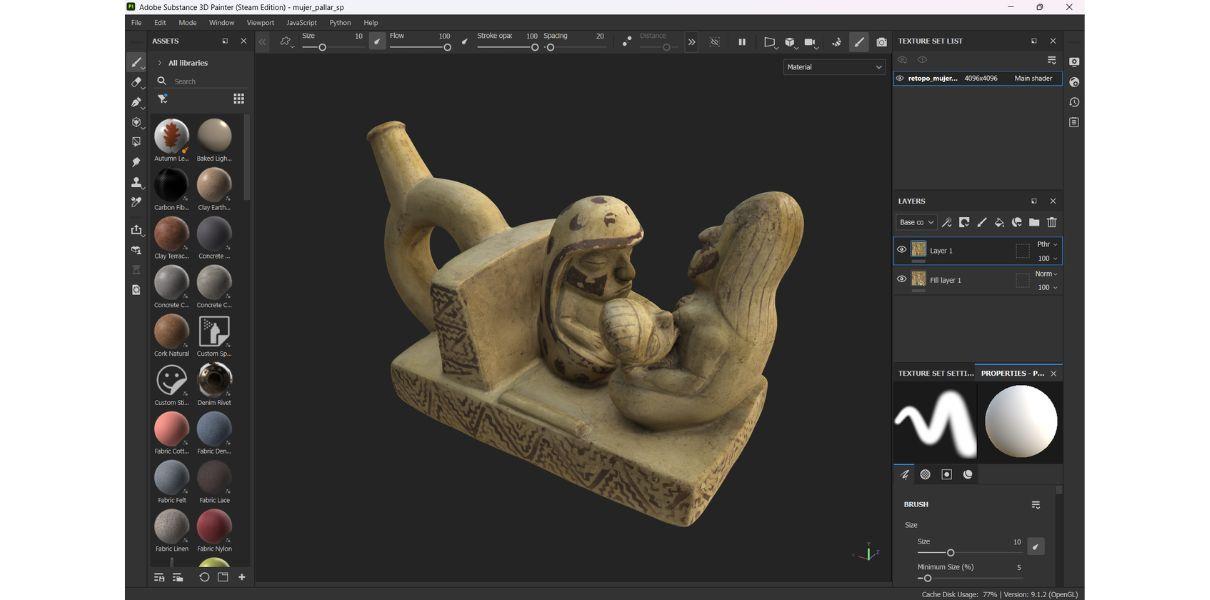
Optimization includes processes such as mesh cleaning, polygon reduction, geometry and topology correction, proper scaling and orientation, texture optimization, UV mapping adjustments, removal of digital noise and artifacts, verification of metric accuracy, and preparation for 3D printing.
Software used for these tasks includes RealityCapture, Blender, ZBrush, Photoshop, CloudCompare, and Adobe Substance 3D Painter.
Where Are 3D Cultural Heritage Models Stored and Shared?
Once the mesh and texture maps are optimized, selecting an appropriate 3D repository is essential for storage and dissemination. Various platforms host photogrammetric heritage models, including Sketchfab, Europeana, CyArk, Smithsonian 3D, Google Arts & Culture, Open Heritage 3D, MorphoSource, and Zenodo.
Sketchfab was chosen as it provides optimal conditions for visualization and public access.
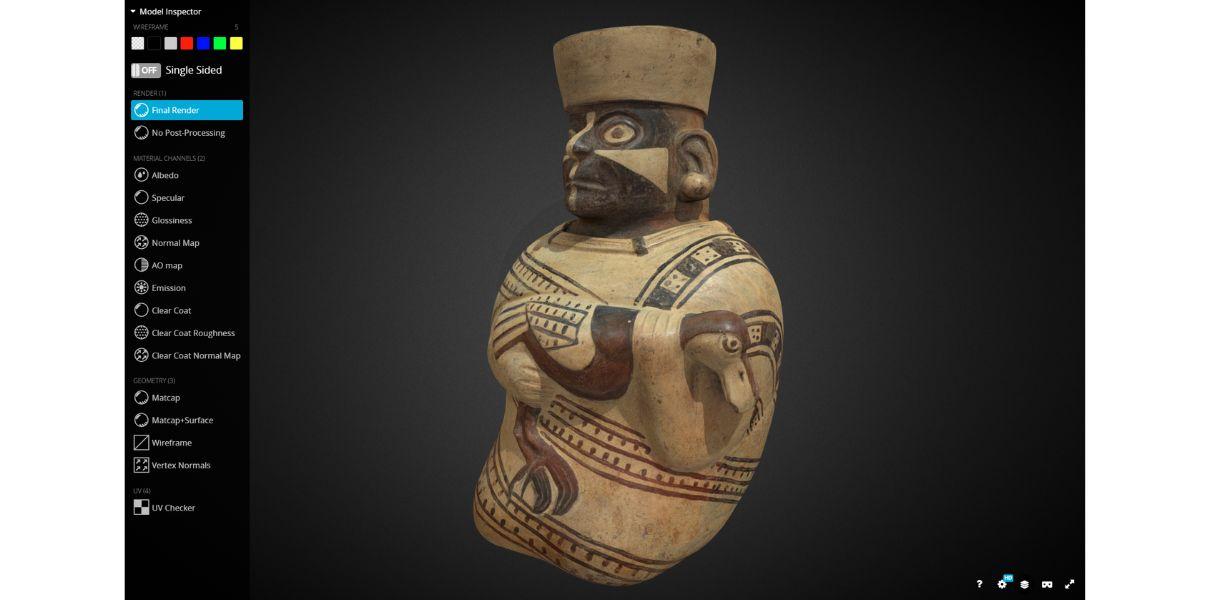
What Challenges Does Artificial Intelligence Pose for Cultural Heritage?
The rise of generative artificial intelligence has become one of the most significant technological developments. While it can produce visually compelling 3D resources, there is a fine line between documenting heritage and constructing non-existent pasts.
At the El Brujo Archaeological Complex, 3D models are based exclusively on real artifacts scientifically excavated, ensuring authenticity and historical accuracy.
Why Is 3D Documentation Key to Democratizing Access to Cultural Heritage?
3D documentation has become an essential tool in the management of archaeological collections. The experience at El Brujo demonstrates that creating digital heritage strengthens research, conservation, and cultural dissemination, enabling diverse audiences to access Peruvian cultural heritage in educational, museum, and social contexts.
Supported by international standards, this methodology shows that technical quality—combined with the use of metadata and paradata—is key to preserving digital memory and democratizing access to cultural heritage.
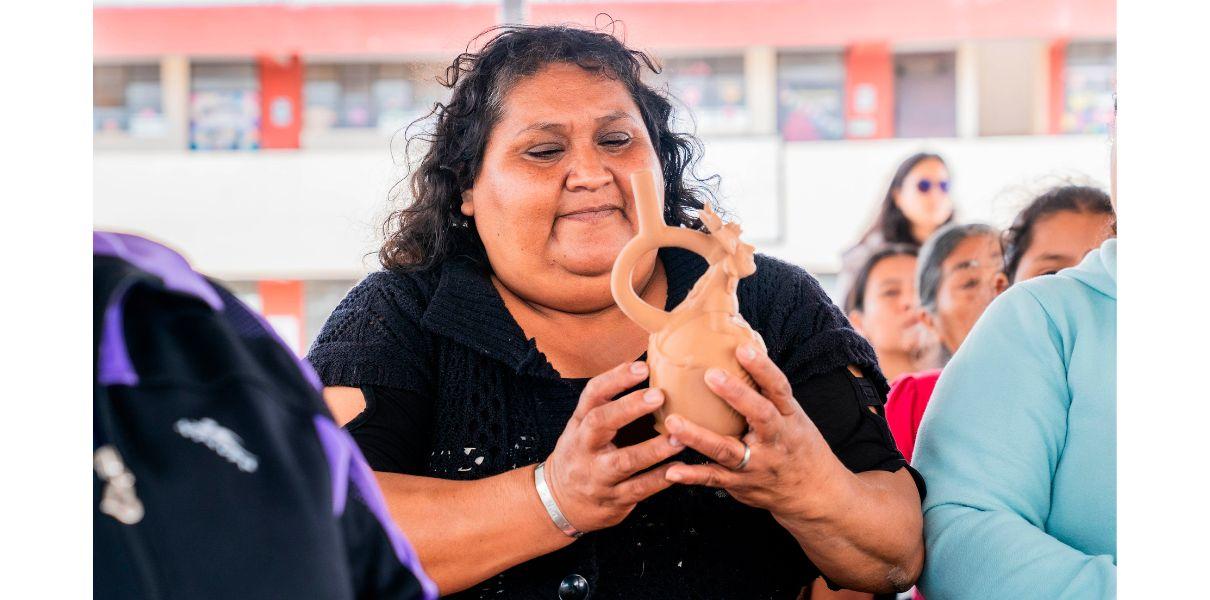
To explore the 3D catalog featuring eleven of the most representative archaeological objects from the El Brujo Archaeological Complex, visit:
https://sketchfab.com/Fundacion-Wiese/models
Bibliography
Ioannides, M. , Karittevli, E. , Panayiotou, P. , & Baker, D. (2025). Integrating paradata, metadata, and data for an effective memory twin in the field of digital cultural heritage. In M. Ioannides, D. Baker, A. Agapiou, & P. Siegkas (Eds. ), 3D Research Challenges in Cultural Heritage V (Lecture Notes in Computer Science, Vol. 15190). Springer. https: //doi. org/10. 1007/978-3-031-78590-0_3
Flynn, T. (2025). AI, authenticity, & the future of 3D cultural heritage: Challenges and opportunities for GLAM in a world of AI-generated content. The Spatial Heritage Review. https: //nebulousflynn. substack. com/p/ai-authenticity-and-the-future-of
UNESCO Chair on Digital Cultural Heritage. (2025). From digital twin to memory twin: A new horizon for cultural heritage. Digital Heritage Research Lab. https: //digitalheritagelab. eu/from-digital-twin-to-memory-twin-a-new-horizon-for-cultural-heritage/
Researchers , outstanding news