- Visitors
- Researchers
- Students
- Community
- Information for the tourist
- Hours and fees
- How to get?
- Visitor Regulations
- Virtual tours
- Classic route
- Mystical route
- Specialized route
- Site museum
- Know the town
- Cultural Spaces
- Cao Museum
- Huaca Cao Viejo
- Huaca Prieta
- Huaca Cortada
- Ceremonial Well
- Walls
- Play at home
- Puzzle
- Trivia
- Memorize
- Crosswords
- Alphabet soup
- Crafts
- Pac-Man Moche
- Workshops and Inventory
- Micro-workshops
- Collections inventory
- News
- Students
- Elite Moche Burial at Huaca Cao Viejo: The Principal Priest
News
CategoriesSelect the category you want to see:
Tumbas de élite mochica en Huaca Cao Viejo: la cámara decorada Moche Elite Tombs at Huaca Cao Viejo: The Decorated Chamb ...
x ...
To receive new news.
By: Complejo arqueológico El Brujo
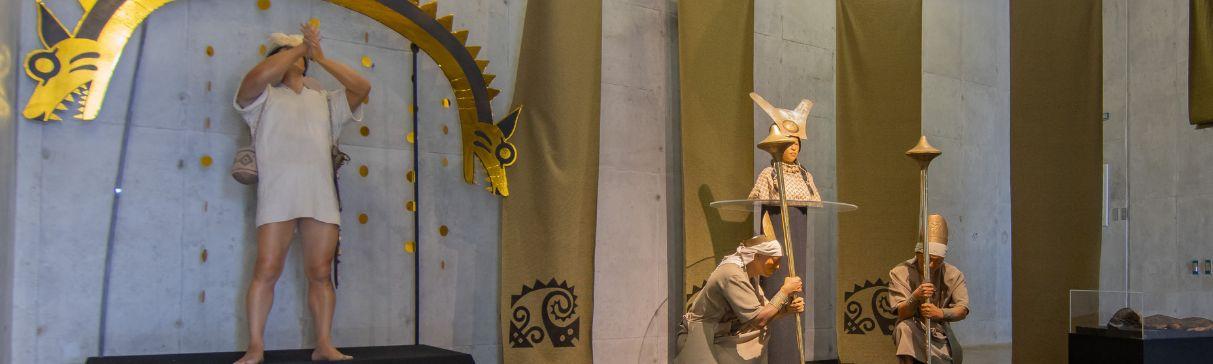
The elite Moche burial documented in Tomb 01 at Huaca Cao Viejo is part of the funerary complex associated with the Lady of Cao. This discovery, recorded in 2004 in the Northwest Enclosure, stands out for the complexity of its funerary structure, its associated burial assemblage, and the genetic analyses carried out subsequently.
Funerary Context of Tomb 01
Tomb 01 is located in the Northwest Enclosure of Huaca Cao Viejo and dates to around 500 AD. The tomb consisted of a rectangular pit 1. 30 m deep containing an adobe coffin with a gabled roof.
Inside, archaeologists found a principal funerary bundle measuring 1. 95 m long by 62 cm wide, with the head oriented toward the south. At the feet of the principal burial, the skeleton of an adolescent was found in a seated position, with the limbs flexed and the body oriented toward the northwest.
Associated Objects: Ceramics
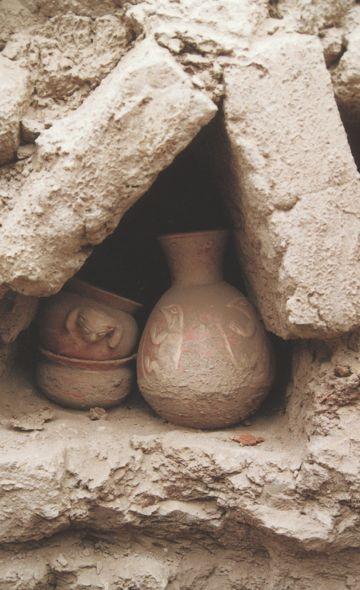
The tomb stood out for the ceramic vessels associated with both the principal funerary bundle and the accompanying individual. The principal bundle was accompanied by two jars.
- The first was decorated with stingray designs and was placed in a small adobe cavity on the southern side.
- The second jar was located at the level of the left arm and featured schematic figures.
The accompanying adolescent also had ceramic offerings. Among them was a Moche stirrup-spout bottle located at the level of the right shoulder.
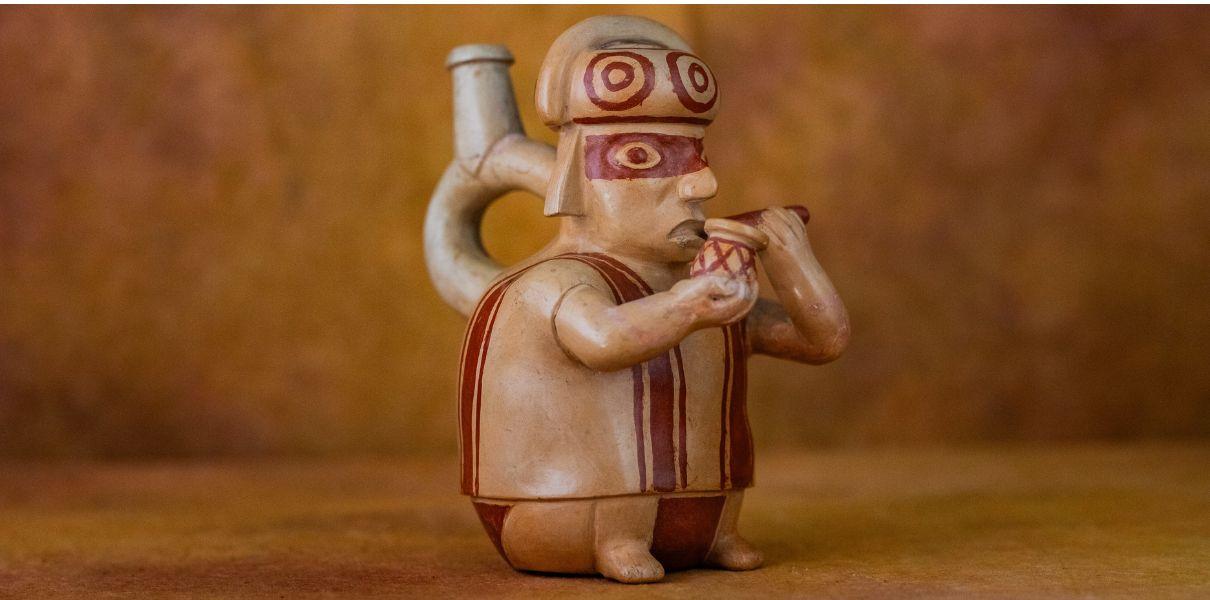
- Moche stirrup-spout bottle (EBBCE00000-56). Explore it in our virtual catalog: [click here]
This vessel depicts a seated figure holding a calero and wearing detailed clothing. A Virú-Gallinazo-style double-bodied bottle with a tubular handle was also found.
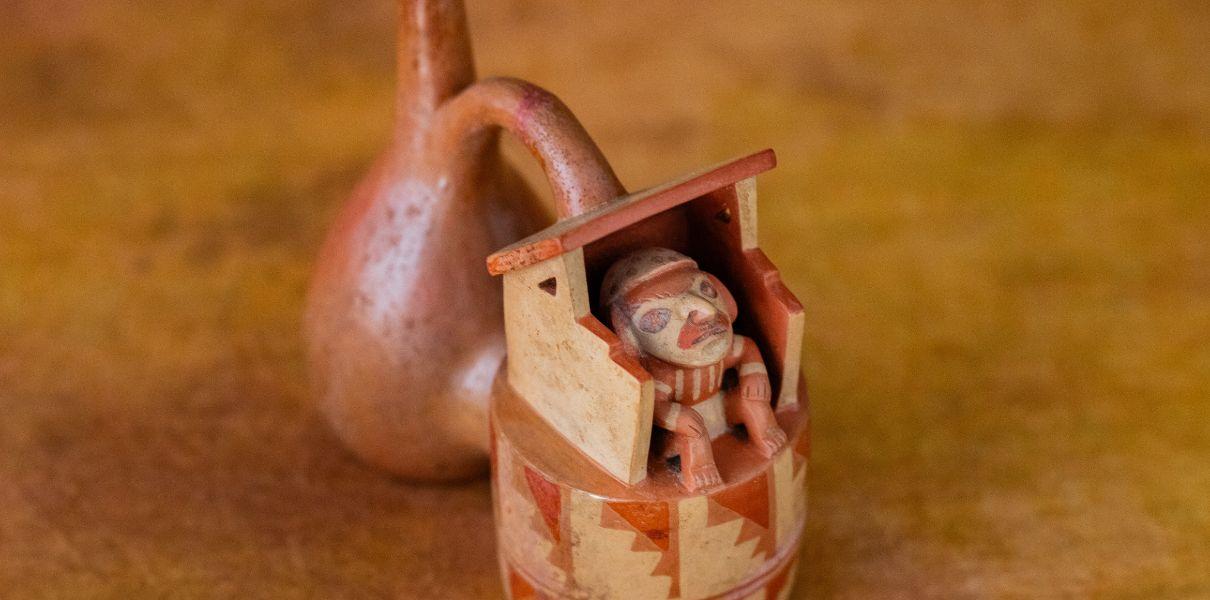
- Virú-Gallinazo-style double-bodied bottle with tubular handle (EBBCE00000-57). Explore it in our virtual catalog: [click here].
Beneath both individuals, archaeologists identified a layer of river sand that directly covered interwoven adobe blocks.
Opening of the Funerary Bundle
The funerary bundle measured approximately 1. 70 m and weighed around 30 kg. It was originally wrapped in a deteriorated reed mat and secured with a cotton cord. Its state of preservation was moderate, with damage exposing some of its eight layers of textiles. Its associated burial assemblage included a cloth covering the head and face.
Liturgical Attire
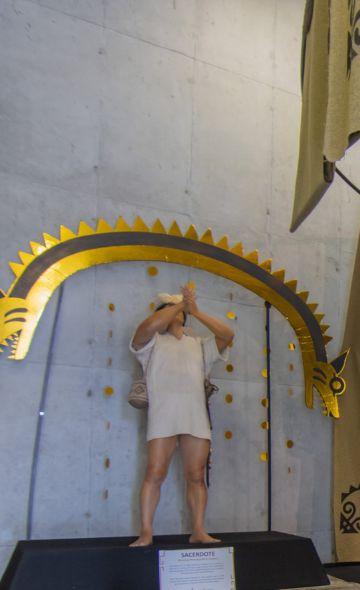
The liturgical attire was discovered in the eighth layer during the unwrapping of the funerary bundle. It stands out for its complexity and for having been made from various materials mounted on a textile and leather base.
The front featured decorative applications of circular metal plates and white and red feathers. The garment was anthropomorphized, incorporating:
- A three-dimensional face
- Hands positioned at face level
- Feet at the bottom
The back shared the same basic structure. It was covered with perforated metal sheets depicting the lunar animal arranged in a mesh-like pattern.
Who Were These Individuals?
Genetic analyses conducted on the skeletal remains of the individuals buried within the Lady of Cao funerary complex made it possible to identify family relationships.
These analyses confirmed that the individual inside the funerary bundle from Tomb 01 and the Lady of Cao were siblings. Likewise, the individual buried alongside the person in the funerary bundle was identified as his son.
The text indicates that the presence of a cord made of plant fibers around the accompanying individual's neck suggests that his death resulted from strangulation.
In Summary
Tomb 01 at Huaca Cao Viejo constitutes a highly significant elite Moche burial. Genetic analyses confirmed the familial relationship between the individual buried in the tomb and the Lady of Cao. His high social status is evidenced by the complex funerary structure and associated burial assemblage.
One of the most notable elements is an anthropomorphized liturgical garment decorated with metal discs and representations of the lunar animal. The tomb provides insight into elite ritual practices within Moche society.
Students , outstanding news